Skip to content
Hearth Home Comfort(612) 555-0148Call Hearth Home Comfort

Whole-home humidification

January air in this house is drier than most deserts

Static shocks on every doorknob, split lips, a piano that will not stay in tune, and gaps opening between the floorboards. All of it is the same problem, and it is fixable.

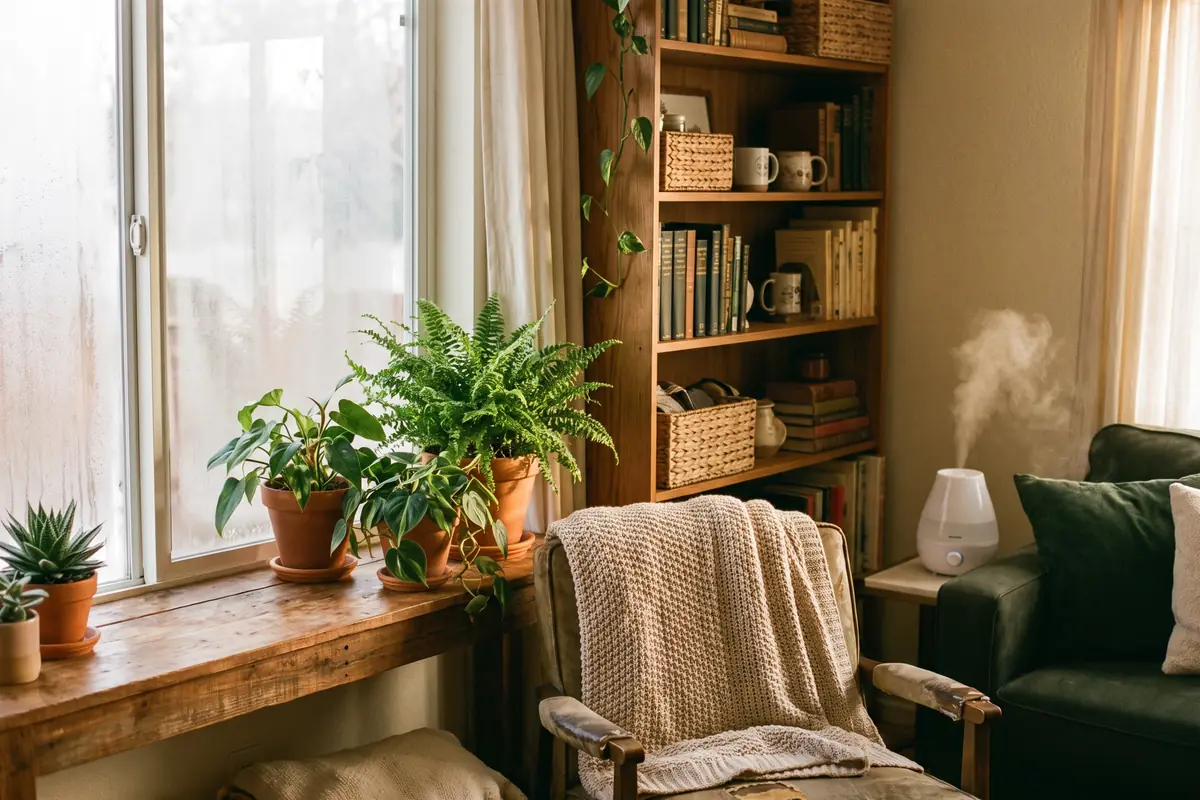
Healthy green houseplants on a sunny windowsill in a warm winter living room

The setting matters more than the machine

This is the single most useful thing on this page. The right indoor humidity is not one number, it moves with the temperature outside, and almost nobody is told that when the unit is fitted.

  1. 20°F and above40%Comfortable for skin, wood and instruments. Most windows will hold this without condensing.
  2. 10 to 20°F35%The usual January setting in a reasonably tight house with decent windows.
  3. 0 to 10°F30%Older single-pane or aluminium-framed windows will start weeping around here.
  4. -10 to 0°F25%Dry, but this is where a century home with original windows has to sit.
  5. Below -10°F20% or lowerA handful of nights a year. Turn it down, then turn it back up when the cold snap breaks.

If you only take one thing from this page: when the cold snap arrives, turn it down. When it breaks, turn it back up.

Three kinds, in ascending order of stubbornness

If your existing unit cannot hold the setting on a cold week, the answer is usually the next one up rather than a bigger version of the same thing.

Bypass

A plate humidifier plumbed across the supply and return, using the furnace blower to push air through a wet pad. Cheapest to fit, needs a bypass duct, and only humidifies while the furnace is actually running.

Fine in a house with long furnace run times and space for the bypass duct.

Fan powered

The same wet pad idea with its own small fan, so it does not need a bypass duct and can add moisture on its own schedule. Roughly a third more output than a bypass unit in the same house.

The usual upgrade when a bypass unit cannot keep up.

Steam

Boils water and injects steam into the supply duct, independent of whether the furnace is heating. Far more output, precise control, and the only type that reliably holds a setpoint in a large or leaky house.

Large houses, very dry seasons, or anywhere the other two have already failed.

Humidity questions

Why is winter air in Minnesota so dry?

It is a physics problem, not a plumbing one. Cold air holds very little water. When outdoor air at 10 below and 70 percent relative humidity leaks into your house and warms to 70 degrees, its relative humidity collapses to around 4 percent. That is drier than most deserts, and your house is doing it continuously all winter.

What should I set the humidistat to?

It changes with the outdoor temperature, which is the part most people are never told. Roughly 40 percent when it is above 20 degrees outside, stepping down to 25 percent or lower during a genuine cold snap. If you set it once in October and leave it, you will be frosting your windows in January.

My windows are frosting on the inside. Is that the humidifier?

Almost always yes, and it means the setting is too high for the temperature outside. Interior frost and condensation are water leaving the air at the coldest surface in the room, which is the glass. Left alone it runs down onto the sill, and over a few winters it rots the wood and grows mould behind the trim. Turn the setting down until the frost stops. That is the correct level for your house right now.

Can I just use a room humidifier?

For one bedroom, yes, and plenty of people do. The trade is refilling it constantly, cleaning it to stop it growing things, and the fact that it only conditions one room. A whole-home unit is plumbed to the water supply, drains to the same place the furnace does, and handles the whole house from one setting.

What maintenance does it need?

The evaporator pad on a bypass or fan powered unit is an annual replacement, and it is genuinely annual, not optional, because a scaled pad stops evaporating. The water panel, solenoid and drain want checking at the same time. Steam units need the canister replaced on a cycle that depends on your water hardness. All of it is part of a comfort plan visit.

Does adding humidity make the house feel warmer?

Slightly, and it is a real effect rather than a sales line. Moist air slows evaporation from your skin, so a house at 68 degrees and 35 percent humidity feels warmer than the same house at 68 and 15 percent. It is not a heating strategy, but it is a genuine part of why a properly humidified house is more comfortable at the same thermostat setting.

There is a longer piece onfrosted windows and humidistat settingsif you want the full version.

We will set it against your windows, not against a chart

A humidity visit checks the unit, replaces the pad, sets the control against your actual glass and your actual outdoor temperature, and shows you how to move it through the winter.