New furnace
A furnace sized for your house, not for the one that was here before
Most replacement furnaces in this city are sized by copying the nameplate off the old one. We measure the house instead, which is slower, costs us more, and is the reason the rooms end up even.
The sizing conversation is the whole conversation
Ask three contractors for a furnace quote and you will usually get three numbers for three different sized machines, none of which came from measuring your house. The default is to read the old nameplate and match it, which quietly carries forward whatever guess was made in 1998.
A Manual J load calculation is the industry standard method and it is not exotic. It is a couple of hours with a tape measure, a window schedule and a spreadsheet, and it produces a BTU figure for your house at 20 below. Everything downstream, the furnace, the blower speed, the duct sizing, hangs off that number.
It is also the reason our quote sometimes comes in a size smaller than everyone else's, which can look like we are trying to cut a corner. We will show you the calculation.
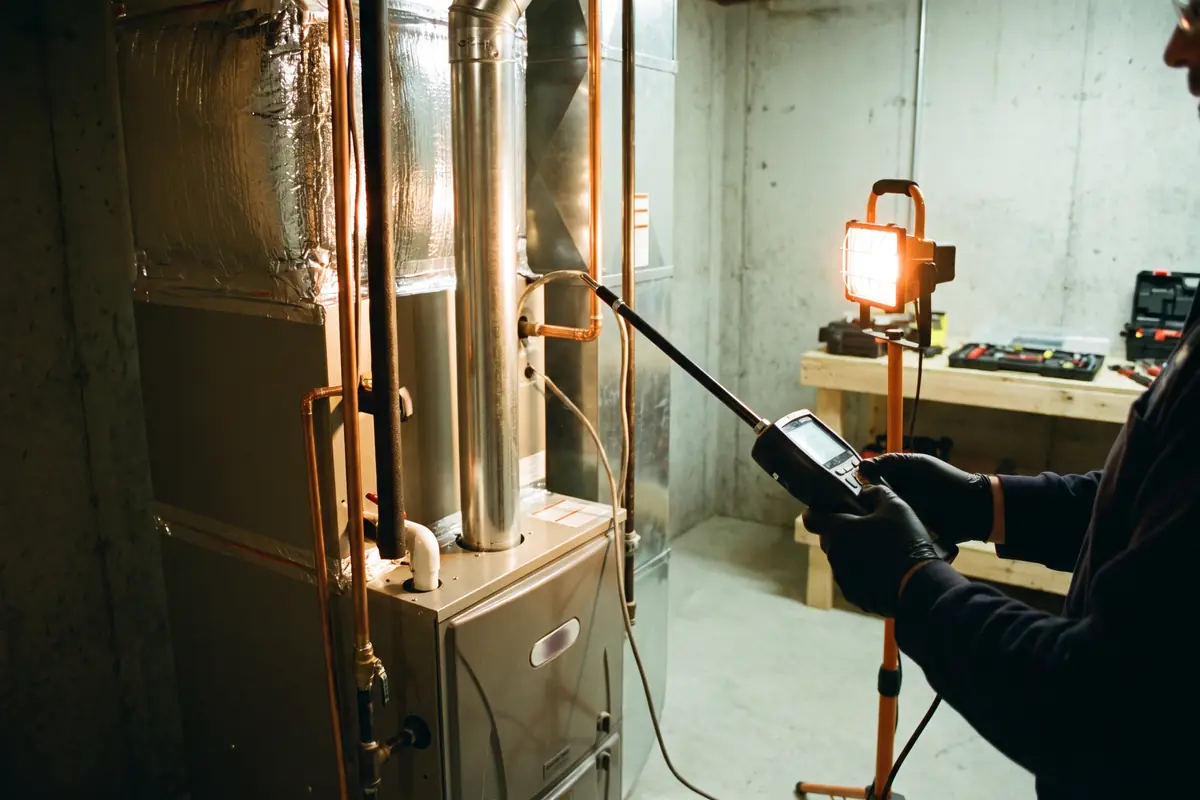
What we specify, and why
Six figures that appear on every quote we write, with the reason each one is there.
- Efficiency
- 95 to 98% AFUE
- The share of the gas that becomes heat in the house. Our heating season is long enough that the top of this range is usually worth it.
- Sizing method
- Manual J
- Room by room load calculation at the local design temperature, not a square footage rule of thumb.
- Temperature rise
- Set to spec
- Measured across the heat exchanger at commissioning and adjusted into the manufacturer range. Skipping this is how heat exchangers die early.
- Static pressure
- Measured, both sides
- If the duct system fights the blower, the best furnace in the catalogue will still be loud and uneven.
- Venting
- Sealed combustion
- Two pipe, drawing outside air for combustion. Better for a tight house and it stops the furnace competing with your bathroom fan.
- Sound
- Under 60 dB typical
- Matters a lot in a Minneapolis bungalow where the return is six feet from a bedroom door.
From first visit to closed permit
Manual J, room by room
We measure the house. Wall assemblies, window area and glazing, insulation depth where we can see it, orientation, air leakage, and what each room is actually asked to do. Two hours of work that decides everything after it.
Ductwork gets looked at, not assumed
Static pressure readings on the existing system, a look at return sizing, and an honest note about whether the ducts can carry what the new furnace will move. A perfect furnace on undersized returns is still a noisy, uneven house.
Two or three real options, in writing
Usually a good single-stage, a two-stage or modulating unit, and where it makes sense, a dual fuel heat pump pairing. Each one with the AFUE, the sound rating, the warranty and the total, including permits.
Install day, one day
Floor protection from the door to the basement. Old unit out, new unit set, venting done properly in the correct pipe with the correct slope, condensate run to a drain rather than a bucket, gas line pressure tested, and everything hauled away.
Commissioning, which is the part most people skip
Gas pressure set to the manufacturer figure, temperature rise measured across the heat exchanger and adjusted into range, blower speed set to the actual duct system, combustion analysed, and every number written down and left with you.
Permit closed and paperwork filed
We pull the permit, we meet the inspector, and we file the rebate paperwork. You get the inspection card, the commissioning sheet and the warranty registration in one folder.
Installation questions
How do you decide what size furnace I need?
A Manual J load calculation on your actual house. Not the nameplate on the old furnace, not square footage times a rule of thumb, and not what the last contractor put in. The old unit is very often oversized, because oversizing was standard practice for decades, and copying it forward just repeats the mistake.
Is an oversized furnace actually a problem?
Yes, and it is the single most common thing we find. An oversized furnace satisfies the thermostat quickly, shuts off, and lets the house drift, so you get a warm room and a cold room and a swing you can feel. It also short cycles, which wears the igniter and the heat exchanger faster than steady running does.
What AFUE should I be looking at?
AFUE is the percentage of the fuel that ends up as heat in your house over a season. In Minnesota the sensible floor is 95 percent, and there are good arguments for 96 to 98 given how long our heating season is. Below about 90 you are venting real money out of the sidewall every winter here, whatever the sticker price saving looks like.
Single stage, two stage or modulating?
Single stage is on or off. Two stage runs at about 65 percent most of the time and steps up when it is genuinely cold. Modulating adjusts continuously. In a long Minnesota heating season the longer, gentler run times of a two-stage or modulating unit are noticeably more comfortable and quieter, and they even out the temperature between rooms. Whether the premium pays back depends on the house.
How long does the installation take?
A straight swap is one day, typically 8am to mid-afternoon. Add a day if the venting route has to change, the return needs enlarging, or we are pairing it with a heat pump. You will not be without heat overnight.
Should I be replacing the air conditioner at the same time?
Only if it is near the end of its life. There is a real efficiency argument for a matched indoor and outdoor pair, and there is a real cost argument for not replacing something that works. We will tell you which one applies rather than bundling by default.
We will do the load calculation before we quote a box
A sizing visit takes about two hours and produces a written Manual J figure for your house. You keep it whoever you end up buying from.