Skip to content
Hearth Home Comfort(612) 555-0148Call Hearth Home Comfort

The live question in Minnesota

Heat pumps work here. The number that matters is the balance point.

A cold-climate heat pump will carry a Minneapolis house through most of the winter more cheaply than gas. What it will not do is carry it through every night in January on its own, and anybody who tells you otherwise is selling.

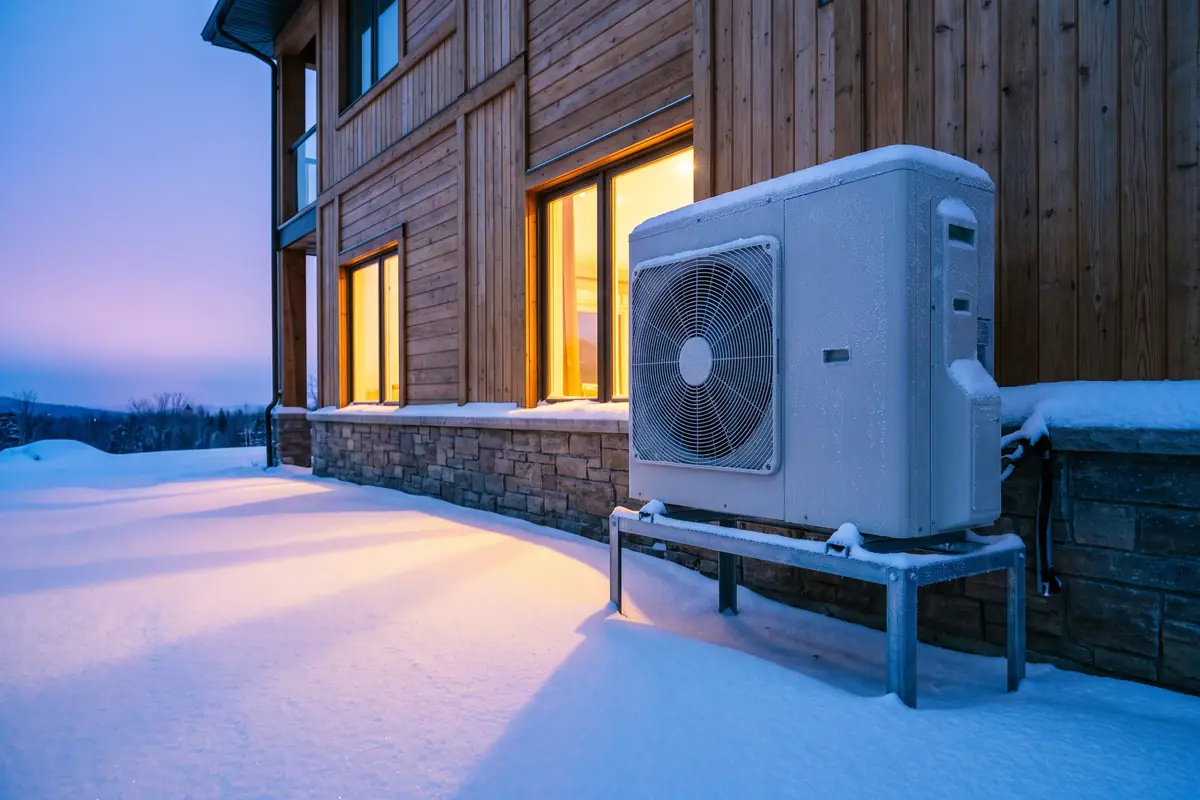
An outdoor heat pump unit on a raised stand in deep snow beside a house at dusk

Two lines, one crossing point

Your house loses heat faster as it gets colder. Your heat pump makes less heat as it gets colder. Draw both against outdoor temperature and they cross once. That crossing is the balance point.

Heat pump output and house heat loss against outdoor temperatureTwo lines crossing at about 8 degrees Fahrenheit. The house heat loss line rises steadily as the outdoor temperature falls. The heat pump output line falls as the outdoor temperature falls. Above the crossing point the heat pump covers the whole load on its own. Below it, backup heat makes up the shortfall. This diagram is illustrative and not a calculation for any particular house.020406080-25-15-5515253545kBTU/hOutdoor temperature, degrees FBalance point
What the house is losingWhat the heat pump can makeIllustrative shape, not a calculation for a specific home.

Above the crossing

The heat pump covers the whole load on its own and the furnace never fires. In a typical Twin Cities winter that is the large majority of the hours between October and April, including most of the cold ones.

Below the crossing

Backup heat makes up the shortfall. In a dual fuel system the control hands over to the furnace automatically at a temperature we set with you, and hands back when it warms up. You do not touch anything.

The numbers we actually use

Not the sticker on the box. These are what we work from when we size a system for a Minnesota house.

Design temperature
-20°F
The outdoor temperature the system has to be able to cope with in this climate zone. Everything is sized against it.
Typical balance point
5 to 15°F
Where the two lines cross in most of the houses we work on. Lower is better, and a tighter house gets there.
Load calculation
Manual J
Room by room, from your actual walls, windows and air leakage. Never from the nameplate on the old equipment.
Cold-weather output
17°F and -5°F
The two capacity table entries that decide whether a unit is genuinely cold-climate or just badged that way.
Seasonal heating rating
HSPF2
Useful for comparing two units. Calculated against a national average climate, so it flatters warm places.
Refrigerant
R-454B
The lower global warming potential replacement now shipping in new residential equipment in place of R-410A.

Three ways this normally goes

Which one fits depends on your ductwork, your gas service and your electric rate, in that order.

Dual fuel

A cold-climate heat pump plus your existing or new gas furnace, with a control that switches between them at a set outdoor temperature. The most common answer in Minneapolis, and usually the cheapest to run across a whole winter.

Best for: a ducted house that already has gas.

All-electric with strip backup

The heat pump does everything, with electric resistance heat in the air handler for the coldest nights. Simple, no combustion in the house, no flue. The trade is that the backup hours are the expensive hours, so the balance point has to be genuinely low.

Best for: a tight house with no gas service, or a homeowner who wants combustion out.

Ductless heads

One outdoor unit feeding wall heads in the rooms that need them, with the existing heating left in place. The realistic answer in a radiator house, a balloon-framed 1910s foursquare, or an addition that was never really conditioned.

Best for: no ductwork, or rooms the ductwork has never reached.

Heat pump questions we get every week

What exactly is a balance point?

It is the outdoor temperature at which your heat pump stops being able to cover what your house is losing. Above it, the heat pump carries the house on its own. Below it, something else makes up the difference. It is a property of your house and your equipment together, not of the equipment alone, which is why two identical heat pumps can have balance points 15 degrees apart in two different houses on the same street.

What happens on the nights below the balance point?

Backup heat runs. In a dual fuel system that is your gas furnace, and the control switches over automatically at a temperature you set. In an all-electric system it is electric resistance strip heat, which works perfectly well but costs considerably more per unit of heat. Which of those is right depends on your rates, your ductwork and whether you have gas at the house at all.

Is a heat pump going to cost me more to run?

Between roughly 15 degrees and 55 degrees, which is most of a Minnesota heating season, a modern heat pump is normally cheaper to run than gas at typical Twin Cities rates. Below the balance point it is normally more expensive. That is the entire economics of the decision, and it is why the switchover temperature matters more than the brand on the box. We will run the numbers against your actual bills before you commit.

Do I have to get rid of my furnace?

No, and in a lot of Minneapolis houses you should not. Keeping a sound furnace as the backup half of a dual fuel system is usually both the cheapest and the most resilient option. It also means that on the one night in February when it is 24 below and the power grid is under strain, you still have a heat source that does not care what the outdoor temperature is.

What is HSPF2 and should I care about it?

HSPF2 is a seasonal efficiency rating for heating, the winter equivalent of SEER2. It is useful for comparing two units, but it is calculated against a national average climate that looks nothing like ours. For a Minnesota house the more useful numbers are the manufacturer capacity tables at 17 degrees and at 5 below, because those tell you what the machine actually produces on the nights that matter here.

Will a heat pump work with the radiators in my 1918 house?

Not directly. Air source heat pumps need either ductwork or ductless heads. In a hydronic house the usual answer is ductless mini splits, either for the whole house or for the rooms the radiators have never handled well. Air-to-water heat pumps exist, but in Minnesota they are still a specialist proposition and we will say so rather than sell you one.

Still deciding?The long version of the balance point piecegoes through it with the arithmetic in the open.

Let us do the load calculation before anyone quotes you a box

A heat pump assessment is a measured Manual J, a balance point figure for your house, and a straight answer about whether this is a good idea for you. It takes about ninety minutes.